Is a Philosophy of the Nature and Meaning of Beauty as It Pertains to Art
Nature has two inter-related meanings in philosophy. On the one paw, information technology means the set of all things which are natural, or subject to the normal working of the laws of nature. On the other hand, it means the essential properties and causes of individual things.
How to sympathise the significant and significance of nature has been a consequent theme of word inside the history of Western Civilization, in the philosophical fields of metaphysics and epistemology, besides as in theology and science. The study of natural things and the regular laws which seem to govern them, every bit opposed to discussion about what it means to be natural, is the area of natural science.
The word "nature" derives from Latin nātūra, a philosophical term derived from the verb for birth, which was used as a translation for the earlier (pre-Socratic) Greek term phusis, derived from the verb for natural growth. Already in classical times, philosophical use of these words combined two related meanings which have in common that they refer to the manner in which things happen by themselves, "naturally", without "interference" from homo deliberation, divine intervention, or annihilation exterior what is considered normal for the natural things being considered.
Understandings of nature depend on the bailiwick and historic period of the piece of work where they appear. For example, Aristotle's explanation of natural backdrop differs from what is meant by natural properties in mod philosophical and scientific works, which can besides differ from other scientific and conventional usage. Stoicism encourages practitioners to live in accordance with nature. Pyrrhonism encourages practitioners to utilize the guidance of nature in decision making.
Classical nature and Aristotelian metaphysics [edit]
The Physics (from ta phusika "the natural [things]") is Aristotle's main work on nature. In Physics II.1, Aristotle defines a nature as "a source or cause of beingness moved and of being at residual in that to which it belongs primarily".[1] In other words, a nature is the principle within a natural raw material that is the source of tendencies to modify or balance in a detail way unless stopped. For case, a rock would fall unless stopped. Natural things stand in contrast to artifacts, which are formed by homo artifice, non because of an innate tendency. (The raw materials of a bed have no trend to become a bed.) In terms of Aristotle's theory of iv causes, the give-and-take natural is applied both to the innate potential of matter crusade and the forms which the matter tends to become naturally.[two]
Co-ordinate to Leo Strauss,[3] the beginning of Western philosophy involved the "discovery or invention of nature" and the "pre-philosophical equivalent of nature" was supplied by "such notions as 'custom' or 'ways'". In ancient Greek philosophy on the other hand, Nature or natures are ways that are "really universal" "in all times and places". What makes nature different is that it presupposes not simply that not all customs and ways are equal, but also that one tin "find one'south bearings in the cosmos" "on the basis of inquiry" (not for example on the basis of traditions or religion). To put this "discovery or invention" into the traditional terminology, what is "by nature" is assorted to what is "by convention". The concept of nature taken this far remains a strong tradition in modern western thinking. Science, co-ordinate to Strauss' commentary of Western history is the contemplation of nature, while technology was or is an try to imitate it.[4]
Going further, the philosophical concept of nature or natures as a special blazon of causation - for instance that the way item humans are is partly caused past something called "human nature" is an essential stride towards Aristotle's teaching concerning causation, which became standard in all Western philosophy until the arrival of mod science.
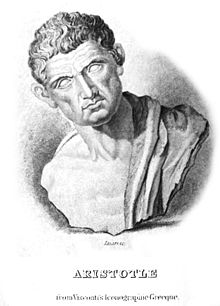
Whether it was intended or not, Aristotle'due south inquiries into this field of study were long felt to have resolved the discussion almost nature in favor of one solution. In this account, there are 4 different types of cause:
- The cloth crusade is the "raw textile" - the matter which undergoes change. One of the causes of a statue being what it is might be that it is statuary. All meanings of the give-and-take nature encompass this simple meaning.
- The efficient cause is the motion of another thing, which makes a thing change, for example a chisel hitting a stone causes a scrap to break off. This is the way which the matter is forming into a form so that it get substance like what Aristotle said that a substance must have a form and matter in lodge to call it substance. This is the motility of changing a single existence into two. This is the virtually obvious fashion in which cause and effect works, as in the descriptions of mod scientific discipline. But according to Aristotle, this does non yet explain that of which the motion is, and we must "utilise ourselves to the question whether in that location is any other crusade per se as well thing".[5]
- The formal cause is the form or idea which serves equally a template towards which things develop - for case post-obit an arroyo based upon Aristotle we could say that a child develops in a way partly determined by a thing called "human nature". Here, nature is a cause.
- The final cause is the aim towards which something is directed. For example, a human aims at something perceived to exist good, every bit Aristotle says in the opening lines of the Nicomachean Ideals.
The formal and last crusade are an essential function of Aristotle'southward "Metaphysics" - his try to go across nature and explain nature itself. In practice they imply a man-like consciousness involved in the causation of all things, even things which are not homo-fabricated. Nature itself is attributed with having aims.[half dozen]
The bogus, like the conventional therefore, is within this co-operative of Western idea, traditionally assorted with the natural. Engineering science was assorted with scientific discipline, equally mentioned higher up. And another essential attribute to this understanding of causation was the stardom between the accidental properties of a thing and the substance - another distinction which has lost favor in the modern era, later having long been widely accustomed in medieval Europe.
To depict it another way, Aristotle treated organisms and other natural wholes as existing at a higher level than mere affair in motion. Aristotle'southward argument for formal and final causes is related to a doctrine about how information technology is possible that people know things: "If nix exists apart from private things, zero will be intelligible; everything volition exist sensible, and there will be no knowledge of anything—unless it be maintained that sense-perception is noesis".[vii] Those philosophers who disagree with this reasoning therefore also encounter knowledge differently from Aristotle.
Aristotle and so, described nature or natures as follows, in a mode quite different from modern science:[8]
"Nature" means:
(a) in ane sense, the genesis of growing things — as would be suggested by pronouncing the υ of φύσις [9] long—and
(b) in another, that immanent thing from which a growing thing commencement begins to grow.
(c) The source from which the primary motion in every natural object is induced in that object every bit such. All things are said to grow which gain increase through something else by contact and organic unity (or adhesion, every bit in the case of embryos). Organic unity differs from contact; for in the latter example there need exist nothing except contact, but in both the things which form an organic unity in that location is some one and the same thing which produces, instead of mere contact, a unity which is organic, continuous and quantitative (but not qualitative). Again, "nature" means
(d) the primary stuff, shapeless and unchangeable from its own authorisation, of which any natural object consists or from which it is produced; e.g., bronze is called the "nature" of a statue and of bronze articles, and wood that of wooden ones, and similarly in all other cases. For each article consists of these "natures," the chief material persisting. It is in this sense that men call the elements of natural objects the "nature," some calling it fire, others globe or air or water, others something else similar, others some of these, and others all of them. Again in another sense "nature" means
(e) the substance of natural objects; every bit in the case of those who say that the "nature" is the main limerick of a thing, or as Empedocles says: Of nil that exists is at that place nature, just only mixture and separation of what has been mixed; nature is but a proper name given to these by men. Hence as regards those things which exist or are produced by nature, although that from which they naturally are produced or exist is already nowadays, we say that they have not their nature still unless they have their form and shape. That which comprises both of these exists by nature; e.g. animals and their parts. And nature is both the chief matter (and this in two senses: either primary in relation to the thing, or primary in general; e.g., in bronze articles the primary thing in relation to those articles is bronze, only in general it is possibly h2o—that is if all things which can be melted are h2o) and the grade or essence, i.e. the terminate of the process, of generation. Indeed from this sense of "nature," by an extension of significant, every essence in full general is called "nature," considering the nature of anything is a kind of essence. From what has been said, then, the chief and proper sense of "nature" is the essence of those things which contain in themselves as such a source of motion; for the affair is chosen "nature" because it is capable of receiving the nature, and the processes of generation and growth are chosen "nature" considering they are motions derived from it. And nature in this sense is the source of motion in natural objects, which is somehow inherent in them, either potentially or actually.—Metaphysics 1014b-1015a, translated past Hugh Tredennick, emphasis added.[a]
It has been argued, as will exist explained below, that this blazon of theory represented an oversimplifying diversion from the debates within Classical philosophy, possibly even that Aristotle saw information technology as a simplification or summary of the debates himself. But in any instance the theory of the four causes became a standard role of whatsoever advanced education in the Middle Ages.
In Eastern philosophy [edit]
![[icon]](https://upload.wikimedia.org/wikipedia/commons/thumb/1/1c/Wiki_letter_w_cropped.svg/20px-Wiki_letter_w_cropped.svg.png) | This section needs expansion. Yous can help by adding to it. (June 2019) |
Indian philosophy [edit]
Jain philosophy attempts to explain the rationale of being and existence, the nature of the Universe and its constituents, the nature of bondage and the means to accomplish liberation.[x] Jainism strongly upholds the individualistic nature of soul and personal responsibility for one'southward decisions; and that self-reliance and individual efforts lonely are responsible for one'south liberation.[eleven]
Ajñana was a Śramaṇa school of radical Indian skepticism and a rival of early Buddhism and Jainism. They held that it was impossible to obtain noesis of metaphysical nature or ascertain the truth value of philosophical propositions;[12] and even if knowledge was possible, it was useless and disadvantageous for final salvation. They were seen as sophists who specialized in refutation without propagating any positive doctrine of their own. Jayarāśi Bhaṭṭa (fl. c. 800), author of the skeptical work entitled Tattvopaplavasiṃha ("The Lion that Devours All Categories"/"The Upsetting of All Principles"), has been seen as an important Ajñana philosopher.[13]
In the Chandogya Upanishad, Aruni asks metaphysical questions concerning the nature of reality and truth, observes constant modify, and asks if at that place is something that is eternal and unchanging. From these questions, embedded in a dialogue with his son, he presents the concept of Ātman (soul, Self) and universal Self.[14] [15]
The Ashtavakra Gita, credited to Aṣṭāvakra, examines the metaphysical nature of existence and the pregnant of individual freedom, presenting its thesis that at that place is only 1 Supreme Reality (Brahman), the entirety of universe is oneness and manifestation of this reality, everything is interconnected, all Self (Atman, soul) are part of that 1, and that individual freedom is not the end point only a given, a starting indicate, innate.[xvi]
The first book of Yoga Vasistha, attributed to Valmiki, presents Rama's frustration with the nature of life, human suffering and disdain for the globe.[17] The second describes, through the graphic symbol of Rama, the desire for liberation and the nature of those who seek such liberation.[17] The quaternary describes the nature of world and many non-dualism ideas with numerous stories.[17] [eighteen] Information technology emphasizes gratis volition and human creative power.[17] [19]
Ancient Mīmāṃsā's key concern was epistemology (pramana), that is what are the reliable means to knowledge. Information technology debated non simply "how does man e'er learn or know, whatever he knows", but as well whether the nature of all knowledge is inherently circular, whether those such as foundationalists who critique the validity of whatever "justified behavior" and knowledge system brand flawed presumptions of the very premises they critique, and how to correctly interpret and avoid incorrectly interpreting dharma texts such every bit the Vedas.[20] To Mīmānsā scholars, the nature of non-empirical cognition and human means to it are such that one can never demonstrate certainty, 1 tin only falsify knowledge claims, in some cases.[20]
Buddhist philosophy's chief concern is soteriological, defined as freedom from dukkha (unease).[21] Because ignorance to the true nature of things is considered 1 of the roots of suffering, Buddhist thinkers concerned themselves with philosophical questions related to epistemology and the employ of reason.[22] Dukkha can be translated every bit "incapable of satisfying,"[23] "the unsatisfactory nature and the general insecurity of all conditioned phenomena"; or "painful."[24] [25] Prajñā is insight or knowledge of the truthful nature of existence. The Buddhist tradition regards ignorance (avidyā), a fundamental ignorance, misunderstanding or mis-perception of the nature of reality, equally ane of the basic causes of dukkha and samsara. By overcoming ignorance or misunderstanding one is enlightened and liberated. This overcoming includes awakening to impermanence and the non-self nature of reality,[26] [27] and this develops dispassion for the objects of clinging, and liberates a being from dukkha and saṃsāra.[28] [29] Pratītyasamutpāda, as well chosen "dependent arising, or dependent origination", is the Buddhist theory to explain the nature and relations of being, condign, existence and ultimate reality. Buddhism asserts that in that location is nil contained, except the state of nirvana.[thirty] All physical and mental states depend on and arise from other pre-existing states, and in plow from them arise other dependent states while they cease.[31]
E Asian philosophies [edit]
Confucianism considers the ordinary activities of human being life—and especially human relationships—every bit a manifestation of the sacred,[32] because they are the expression of humanity's moral nature (xìng 性), which has a transcendent anchorage in Heaven (Tiān 天) and unfolds through an appropriate respect for the spirits or gods (shén) of the world.[33] Tiān (天), a fundamental concept in Chinese thought, refers to the God of Heaven, the northern culmen of the skies and its spinning stars,[34] earthly nature and its laws which come from Heaven, to "Heaven and Earth" (that is, "all things"), and to the awe-inspiring forces across human control.[35] Confucius used the term in a mystical way.[36] It is like to what Taoists meant by Dao: "the mode things are" or "the regularities of the earth",[35] which Stephan Feuchtwang equates with the ancient Greek concept of physis, "nature" as the generation and regenerations of things and of the moral order.[37] Feuchtwang explains that the difference between Confucianism and Taoism primarily lies in the fact that the former focuses on the realisation of the starry guild of Heaven in human society, while the latter on the contemplation of the Dao which spontaneously arises in nature.[37]
Modernistic scientific discipline and laws of nature: trying to avert metaphysics [edit]

A Renaissance imagined representation of Democritus, the laughing philosopher, by Agostino Carracci
In dissimilarity, Modern Science took its distinctive turn with Francis Bacon, who rejected the four distinct causes, and saw Aristotle as someone who "did proceed in such a spirit of deviation and contradiction towards all antiquity: undertaking not but to frame new words of science at pleasure, but to confound and extinguish all ancient wisdom". He felt that lesser known Greek philosophers such as Democritus "who did not suppose a listen or reason in the frame of things", have been arrogantly dismissed because of Aristotelianism leading to a situation in his time wherein "the search of the physical causes hath been neglected, and passed in silence".[38]
And and so Bacon advised...
Physic doth make inquiry, and take consideration of the same natures : but how? Merely every bit to the material and efficient causes of them, and not every bit to the forms. For example; if the cause of whiteness in snow or froth be inquired, and information technology be rendered thus, that the subtile intermixture of air and water is the crusade, it is well rendered ; but, yet, is this the grade of whiteness? No; but it is the efficient, which is ever but vehiculum formæ. This part of metaphysique I do not find laboured and performed...

In his Novum Organum Bacon argued that the simply forms or natures we should hypothesize are the "simple" (equally opposed to chemical compound) ones such as the ways in which rut, motility, etc. work. For example, in adage 51 he writes:
51. The human being agreement is, past its ain nature, prone to abstraction, and supposes that which is fluctuating to be fixed. But it is ameliorate to dissect than abstract nature; such was the method employed by the school of Democritus, which made greater progress in penetrating nature than the rest. It is best to consider matter, its conformation, and the changes of that conformation, its ain action, and the law of this activeness or motion, for forms are a mere fiction of the human mind, unless you volition call the laws of activeness by that name.
Post-obit Bacon's communication, the scientific search for the formal cause of things is at present replaced by the search for "laws of nature" or "laws of physics" in all scientific thinking. To employ Aristotle's well-known terminology these are descriptions of efficient cause, and not formal cause or concluding crusade. It means modern science limits its hypothesizing virtually non-concrete things to the assumption that there are regularities to the ways of all things which do not change.
These full general laws, in other words, replace thinking most specific "laws", for example "human nature". In modernistic science, human nature is part of the aforementioned general scheme of cause and effect, obeying the same full general laws, equally all other things. The above-mentioned difference between accidental and substantial backdrop, and indeed cognition and opinion, too disappear inside this new approach that aimed to avert metaphysics.
As Salary knew, the term "laws of nature" was one taken from medieval Aristotelianism. St Thomas Aquinas for instance, divers police so that nature really was legislated to consciously attain aims, like human police: "an ordinance of reason for the common skillful, made by him who has intendance of the community and promulgated".[39] In contrast, roughly gimmicky with Bacon, Hugo Grotius described the constabulary of nature as "a rule that [can] be deduced from fixed principles by a sure procedure of reasoning".[40] And later still, Montesquieu was even farther from the original legal metaphor, describing laws vaguely as "the necessary relations deriving from the nature of things".[41]

I of the most of import implementors of Bacon'southward proposal was Thomas Hobbes, whose remarks apropos nature are especially well-known. His most famous work, Leviathan, opens with the give-and-take "Nature" and then parenthetically defines information technology every bit "the art whereby God hath made and governes the world". Despite this pious description, he follows a Baconian arroyo. Following his contemporary, Descartes, Hobbes describes life itself equally mechanical, caused in the same fashion every bit clockwork:
For seeing life is but a motion of Limbs, the kickoff whereof is in some principall office inside; why may we not say, that all Automata (Engines that move themselves past springs and wheeles as doth a watch) accept an artificiall life?
On this basis, already existence established in natural science in his lifetime, Hobbes sought to discuss politics and human being life in terms of "laws of nature". But in the new modern approach of Bacon and Hobbes, and before them Machiavelli (who all the same never clothed his criticism of the Aristotelian approach in medieval terms like "laws of nature"),[42] such laws of nature are quite different to human laws: they no longer imply whatsoever sense of better or worse, simply simply how things really are, and, when in reference to laws of human nature, what sorts of man behavior tin be most relied upon.
"Late modern" nature [edit]

Jean-Jacques Rousseau: a civilized man, but a person who questioned whether civilization was according to human nature.
Having disconnected the term "law of nature" from the original medieval metaphor of man-made law, the term "law of nature" is now used less than in early modern times.
To accept the critical instance of human nature, every bit discussed in ethics and politics, once early modern philosophers such as Hobbes had described human nature equally whatever you lot could expect from a mechanism chosen a human, the betoken of speaking of human being nature became problematic in some contexts.
In the late 18th century, Rousseau took a critical step in his 2nd Discourse, reasoning that human nature as we know it, rational, and with linguistic communication, and and then on, is a event of historical accidents, and the specific up-bringing of an individual. The consequences of this line of reasoning were to be enormous. Information technology was all about the question of nature. In effect it was beingness claimed that human nature, ane of the about important types of nature in Aristotelian thinking, did not exist every bit it had been understood to be.
The survival of metaphysics [edit]
The approach of modern science, like the approach of Aristotelianism, is apparently non universally accepted by all people who take the concept of nature every bit a reality which nosotros can pursue with reason.
Salary and other opponents of Metaphysics merits that all attempts to go beyond nature are leap to fall into the same errors, simply Metaphysicians themselves see differences between unlike approaches.
Immanuel Kant for example, expressed the demand for a Metaphysics in quite similar terms to Aristotle.
...though nosotros cannot know these objects equally things in themselves, we must nonetheless be in a position at least to think them as things in themselves; otherwise nosotros should be landed in the absurd conclusion that in that location can exist appearance without annihilation that appears.
Every bit in Aristotelianism then, Kantianism claims that the homo mind must itself have characteristics which are beyond nature, metaphysical, in some mode. Specifically, Kant argued that the human mind comes ready-fabricated with a priori programming, so to speak, which allows information technology to brand sense of nature.
The study of nature without metaphysics [edit]
Authors from Nietzsche to Richard Rorty have claimed that scientific discipline, the written report of nature, can and should exist without metaphysics. Simply this claim has always been controversial. Authors like Bacon and Hume never denied that their utilize of the word "nature" implied metaphysics, but tried to follow Machiavelli's approach of talking virtually what works, instead of claiming to understand what seems impossible to understand.
See likewise [edit]
- A priori and a posteriori
- Aristotelianism
- Causality
- Empiricism
- Human nature
- Idealism
- Metaphysical naturalism
- Natural philosophy
- Nature
- Saṃsāra
- Naturphilosophie
- Philosophical naturalism
- Platonism
- Reality
- Truth
Notes [edit]
- ^ Greek, with accent added as a guide: φύσις λέγεται ἕνα μὲν τρόπον ἡ τῶν φυομένων γένεσις, οἷον εἴ τις ἐπεκτείνας λέγοι τὸ υ, ἕνα δὲ ἐξ οὗ φύεται πρώτου τὸ φυόμενον ἐνυπάρχοντος: ἔτι ὅθεν ἡ κίνησις ἡ πρώτη ἐν ἑκάστῳ τῶν φύσει ὄντων ἐν αὐτῷ ᾗ αὐτὸ [20] ὑπάρχει: φύεσθαι δὲ λέγεται ὅσα αὔξησιν ἔχει δι᾽ ἑτέρου τῷ ἅπτεσθαι καὶ συμπεφυκέναι ἢ προσπεφυκέναι ὥσπερ τὰ ἔμβρυα: διαφέρει δὲ σύμφυσις ἁφῆς, ἔνθα μὲν γὰρ οὐδὲν παρὰ τὴν ἁφὴν ἕτερον ἀνάγκη εἶναι, ἐν δὲ τοῖς συμπεφυκόσιν ἔστι τι ἓν τὸ αὐτὸ ἐν ἀμφοῖν ὃ ποιεῖ ἀντὶ τοῦ [25] ἅπτεσθαι συμπεφυκέναι καὶ εἶναι ἓν κατὰ τὸ συνεχὲς καὶ ποσόν, ἀλλὰ μὴ κατὰ τὸ ποιόν. ἔτι δὲ φύσις λέγεται ἐξ οὗ πρώτου ἢ ἔστιν ἢ γίγνεταί τι τῶν φύσει ὄντων, ἀρρυθμίστου ὄντος καὶ ἀμεταβλήτου ἐκ τῆς δυνάμεως τῆς αὑτοῦ, οἷον ἀνδριάντος καὶ τῶν σκευῶν τῶν χαλκῶν ὁ χαλκὸς ἡ [xxx] φύσις λέγεται, τῶν δὲ ξυλίνων ξύλον: ὁμοίως δὲ καὶ ἐπὶ τῶν ἄλλων: ἐκ τούτων γάρ ἐστιν ἕκαστον διασωζομένης τῆς πρώτης ὕλης: τοῦτον γὰρ τὸν τρόπον καὶ τῶν φύσει ὄντων τὰ στοιχεῖά φασιν εἶναι φύσιν, οἱ μὲν πῦρ οἱ δὲ γῆν οἱ δ᾽ ἀέρα οἱ δ᾽ ὕδωρ οἱ δ᾽ ἄλλο τι τοιοῦτον λέγοντες, οἱ δ᾽ [35] ἔνια τούτων οἱ δὲ πάντα ταῦτα. ἔτι δ᾽ ἄλλον τρόπον λέγεται ἡ φύσις ἡ τῶν φύσει ὄντων οὐσία, οἷον οἱ λέγοντες τὴν φύσιν εἶναι τὴν πρώτην σύνθεσιν, ἢ ὥσπερ Ἐμπεδοκλῆς λέγει ὅτι "φύσις οὐδενὸς ἔστιν ἐόντων, ἀλλὰ μόνον μῖξίς τε διάλλαξίς τε μιγέντων ἔστι, φύσις δ᾽ ἐπὶ τοῖς ὀνομάζεται ἀνθρώποισιν. "Empedocles Fr. 8 διὸ καὶ ὅσα φύσει ἔστιν ἢ γίγνεται, ἤδη ὑπάρχοντος ἐξ οὗ πέφυκε γίγνεσθαι ἢ εἶναι, οὔπω φαμὲν [5] τὴν φύσιν ἔχειν ἐὰν μὴ ἔχῃ τὸ εἶδος καὶ τὴν μορφήν. φύσει μὲν οὖν τὸ ἐξ ἀμφοτέρων τούτων ἐστίν, οἷον τὰ ζῷα καὶ τὰ μόρια αὐτῶν: φύσις δὲ ἥ τε πρώτη ὕλη (καὶ αὕτη διχῶς, ἢ ἡ πρὸς αὐτὸ πρώτη ἢ ἡ ὅλως πρώτη, οἷον τῶν χαλκῶν ἔργων πρὸς αὐτὰ μὲν πρῶτος ὁ χαλκός, ὅλως δ᾽ [x] ἴσως ὕδωρ, εἰ πάντα τὰ τηκτὰ ὕδωρ) καὶ τὸ εἶδος καὶ ἡ οὐσία: τοῦτο δ᾽ ἐστὶ τὸ τέλος τῆς γενέσεως. μεταφορᾷ δ᾽ ἤδη καὶ ὅλως πᾶσα οὐσία φύσις λέγεται διὰ ταύτην, ὅτι καὶ ἡ φύσις οὐσία τίς ἐστιν. ἐκ δὴ τῶν εἰρημένων ἡ πρώτη φύσις καὶ κυρίως λεγομένη ἐστὶν ἡ οὐσία ἡ τῶν ἐχόντων [fifteen] ἀρχὴν κινήσεως ἐν αὑτοῖς ᾗ αὐτά: ἡ γὰρ ὕλη τῷ ταύτης δεκτικὴ εἶναι λέγεται φύσις, καὶ αἱ γενέσεις καὶ τὸ φύεσθαι τῷ ἀπὸ ταύτης εἶναι κινήσεις. καὶ ἡ ἀρχὴ τῆς κινήσεως τῶν φύσει ὄντων αὕτη ἐστίν, ἐνυπάρχουσά πως ἢ δυνάμει ἢ ἐντελεχείᾳ.
References [edit]
- ^ Aristotle Physics 192b21
- ^ Aristotle Physics 193b21
- ^ "Progress or Render" in An Introduction to Political Philosophy: X Essays by Leo Strauss. (Expanded version of Political Philosophy: Six Essays past Leo Strauss, 1975.) Ed. Hilail Gilden. Detroit: Wayne Land Upwardly, 1989.
- ^ Strauss and Cropsey eds. History of Political Philosophy, Third edition, p.209.
- ^ Metaphysics 995b, translated by Hugh Tredennick. Greek: μάλιστα δὲ ζητητέον καὶ πραγματευτέον πότερον ἔστι τι παρὰ τὴν ὕλην αἴτιον καθ᾽ αὑτὸ ἢ οὔ
- ^ Equally for example Aristotle Politics 1252b.i: "Thus the female and the slave are by nature distinct (for nature makes zero as the cutlers make the Delphic knife, in a niggardly way, but one matter for one purpose; for so each tool volition exist turned out in the finest perfection, if it serves not many uses merely one"
- ^ Metaphysics 999b, translated by Hugh Tredennick. Greek: εἰ μὲν οὖν μηδέν ἐστι παρὰ τὰ καθ᾽ ἕκαστα, οὐθὲν ἂν εἴη νοητὸν ἀλλὰ πάντα αἰσθητὰ καὶ ἐπιστήμη οὐδενός, εἰ μή τις εἶναι λέγει τὴν αἴσθησιν ἐπιστήμην.
- ^ Ducarme, Frédéric; Couvet, Denis (2020). "What does 'nature' mean?". Palgrave Communications. Springer Nature. 6 (14). doi:10.1057/s41599-020-0390-y.
- ^ Phusis is the Greek word for Nature, and Aristotle is cartoon attention to the similarity it has to the verb used to describe natural growth in a plant, phusei. Indeed the first utilize of the give-and-take involves a plant: ὣς ἄρα φωνήσας πόρε φάρμακον ἀργεϊφόντης ἐκ γαίης ἐρύσας, καί μοι φύσιν αὐτοῦ ἔδειξε. "So saying, Argeiphontes [=Hermes] gave me the herb, cartoon it from the ground, and showed me its nature." Odyssey 10.302-3 (ed. A.T. Murray).
- ^ Warren, Herbert (2001). Jainism. Delhi: Crest Publishing House. ISBN978-81-242-0037-7.
- ^ Carrithers, Michael (June 1989). "Naked Ascetics in Southern Digambar Jainism". Homo. New Series. 24 (two): 219–235. JSTOR 2803303. p. 220
- ^ Jayatilleke, Grand.North. (1963). Early Buddhist Theory of Noesis (PDF) (1st ed.). London: George Allen & Unwin Ltd. pp. 112–113.
- ^ Salunkhe, AH (2009). Astikshiromani Charvaka (in Marāthi). Satara: Lokayat Prakashan. p. 36.
- ^ Ben-Ami Scharfstein (1998). A Comparative History of World Philosophy: From the Upanishads to Kant. State University of New York Printing. pp. 56–61. ISBN978-0-7914-3683-7.
- ^ Ben-Ami Scharfstein (1998), A comparative history of globe philosophy: from the Upanishads to Kant, Albany: State University of New York Press, pp. 9-11
- ^ James G. Lochtefeld (2002). The Illustrated Encyclopedia of Hinduism: A-M . The Rosen Publishing Group. p. 66. ISBN978-0-8239-3179-8.
- ^ a b c d Chapple, Christopher (1984). "Introduction". The Concise Yoga Vāsiṣṭha. Translated by Venkatesananda, Swami. Albany: State University of New York Press. pp. eleven–12. ISBN0-87395-955-8. OCLC 11044869.
- ^ Venkatesananda, S (Translator) (1984). The Concise Yoga Vāsiṣṭha. Albany: Land University of New York Press. pp. 117–158. ISBN0-87395-955-8.
- ^ Surendranath Dasgupta, A History of Indian Philosophy, Volume 2, Cambridge University Printing, ISBN 978-0521047791, pages 252-253
- ^ a b Daniel Arnold (2001). "Of Intrinsic Validity: A Study on the Relevance of Pūrva Mīmāṃsā". Philosophy East and West. University of Hawai'i Press. 51 (ane): 27–32. doi:10.1353/pew.2001.0002. JSTOR 1400034. S2CID 144863536.
- ^ Gunnar Skirbekk, Nils Gilje, A history of Western thought: from ancient Greece to the twentieth century. seventh edition published by Routledge, 2001, p. 25.
- ^ Siderits, Marker. Buddhism as philosophy, 2007, p. vi
- ^ Ajahn Sumedho, The First Noble Truth (nb: links to index-page; click "The Get-go Noble Truth" for right page.
- ^ Nyanatiloka (1980), Buddhist Lexicon, p.65, Buddhist Publication Lodge
- ^ Emmanuel, Steven Grand. (2015), A Companion to Buddhist Philosophy, pp.26–31, John Wiley & Sons
- ^ Trainor, Kevin (2004), Buddhism: The Illustrated Guide, Oxford University Press, p. 74, ISBN978-0195173987
- ^ Conze, Edward (2013), Buddhist Thought in India: Three Phases of Buddhist Philosophy, Routledge, pp. 39–xl, ISBN978-1134542314
- ^ Merv Fowler (1999). Buddhism: Beliefs and Practices. Sussex Bookish Printing. pp. 49–52. ISBN978-i-898723-66-0.
- ^ Joseph Mitsuo Kitagawa; Frank E. Reynolds; Theodore M. Ludwig (1980). Transitions and Transformations in the History of Religions: Essays in Honor of Joseph M. Kitagawa. Brill Bookish. pp. 56–58. ISBN978-ninety-04-06112-5. , Quote: Suffering describes the condition of samsaric (this worldly) existence that arises from deportment generated past ignorance of anatta and anicca. The doctrines of no-self and impermanence are thus the keystones of dhammic social club."
- ^ Harvey, Peter (1990), An Introduction to Buddhism: Teachings, History and Practices, Cambridge University Press, p. 54, ISBN978-0521313339
- ^ John Bowker, The Oxford Dictionary of World Religions (1997), Oxford University Press, ISBN 0-19-213965-7
- ^ Adler, Joseph A. (2014), Confucianism every bit a Religious Tradition: Linguistic and Methodological Problems (PDF), Gambier, Ohio, Us: Kenyon Higher, p. 12
- ^ Littlejohn, Ronnie (2010), Confucianism: An Introduction, I.B. Tauris, pp. 34–36, ISBN978-i-84885-174-0
- ^ Didier, John C. (2009). "In and Outside the Square: The Sky and the Power of Conventionalities in Ancient Mainland china and the Earth, c. 4500 BC – Advertising 200". Sino-Platonic Papers (192). Volume I: The Ancient Eurasian Earth and the Celestial Pin, Book II: Representations and Identities of High Powers in Neolithic and Statuary Prc, Volume 3: Terrestrial and Celestial Transformations in Zhou and Early-Imperial Cathay.
- ^ a b Hagen, Kurtis. "Confucian Key Terms – Tian 天". Country University of New York at Plattsburgh. Archived from the original on iii December 2014.
- ^ Hsu, Hope (16 November 2014). "The Ceremonious Theology of Confucius' "Tian" Symbol". Voegelin View.
- ^ a b Feuchtwang, Stephan (2016), "Chinese religions", in Woodhead, Linda; Kawanami, Hiroko; Partridge, Christopher H. (eds.), Religions in the Modern World: Traditions and Transformations (3nd ed.), London: Routledge, p. 146, ISBN978-ane-317-43960-eight
- ^ Bacon (1905). "2.Seven.7". Advancement of Learning. p. xc.
- ^ Summa Theologiae I-II Q90, A4
- ^ On the Law of War and Peace, Proleg. 40
- ^ The Spirit of the Laws, opening lines
- ^ The Prince 15:- "...since my intent is to write something useful to whoever understands it, it has appeared to me more fitting to go direct to the effectual truth of the thing than to the imagination of it. And many have imagined republics and principalities that have never been seen or known to exist in truth; for information technology is and so far from how 1 lives to how one should live that he who lets go of what is washed for what should be done learns his ruin rather than his preservation. For a man who wants to brand a profession of good in all regards must come up to ruin amid so many who are not practiced. Hence information technology is necessary to a prince, if he wants to maintain himself, to learn to be able not to be expert, and to apply this and not use it according to necessity."
Further reading [edit]
- Gerard Naddaf, The Greek Concept of Nature, New York, State Academy of New York Press, 2005.
- Ducarme, Frédéric; Couvet, Denis (2020). "What does 'nature' hateful?". Palgrave Communications. Springer Nature. 6 (14). doi:ten.1057/s41599-020-0390-y.
Source: https://en.wikipedia.org/wiki/Nature_(philosophy)
0 Response to "Is a Philosophy of the Nature and Meaning of Beauty as It Pertains to Art"
Publicar un comentario